Totoks
For a long time after WWII the most common Dutch term to designate Indos was 'Indische Nederlanders' (Indies Dutchmen), sometimes shortened to 'Indischen'. This term however does not only refer to Indos, but also includes the white Dutchmen from the Dutch East Indies. The full blooded Dutchman was known as Totok, short for Totok Belanda. Totok is the Malay term for full blooded person.
Totoks could be the typical Dutch expats, but also Dutch settlers (semi-immigrants). The first were known by the name "Trekkers' (Sojourners) the latter by the name 'Blijvers' (Stayers).
Officially Indos were equal to Totoks and both belonged to the European legal class. Nevertheless the majority of Indos clearly belonged to a different social group, as colonial society was sodden with intricate racial discrimination. In this colonial atmosphere the white Dutchman represented an ideal to aspire to, a rolemodel all non-white peoples should want to emulate. Ironically when talented Indos persevered and obtained positions at the top of the colonial hiearchy, among the totok elite, they often disregarded their old social class.
Many Totoks ethical and non-ethical alike believed in 'la noblesse de la peau' and as 'la noblesse oblige' did their best to uphold their reputation of superiority. While Totoks didnt much fraternize with Indos in the Dutch East Indies this changed after WWII. Only during the great repatriation to the Netherlands, that heralded the Indo diaspora, Indos first saw white Dutchmen doing manual labour, something unheard of in the colony. Back in the Netherlands Totoks and Indos eventually joined forces under the umbrella term Indische Nederlanders to lobby for common causes.
Many members of colonial Totok families remained prominent back home and some with sincere love for the Indies became important supporters of Indo culture. The most outstanding and popular figures in modern Dutch literature are the first generation author Hellas Haasse and second generation author Adriaan van Dis (around 2011 van Dis uncovered the eurasian roots of his father). Another prominent writer is Rudy Kousbroek.
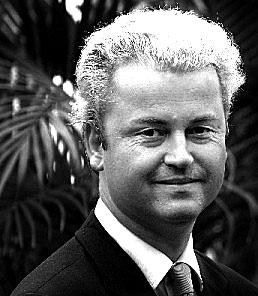
In politics Dutch prime minister Mark Rutte and the much respected former Ministers of Foreign Affairs were Hans Van den Broek and Ben Bot [Ben Bot at the opening of the Pasar Malam Indonesia 2010 ] are from Totok families. Other high profile politicians are Frits Bolkenstein and Geert Wilders. Both are claimed to be of Indo descent, however do not recognise this themselves. More slightly controversial individuals include journalist Willem Oltmans.
The most famous Dutch war hero and resistance fighter is Erik Hazelhoff Roelfzema (Surabaya 1917), also known as the Soldier of Orange. In the Paul Verhoeven movie of the same name he was played by actor Rutger Hauer.
Finally Wim Kan is a legendary, and during his lifetime very influential opininion making cabaret artist, known for tenaciously tackling the post war relationship between the Netherlands & the Japanese emperor Hirohito. Although born in the Netherlands he spent the war in Japanese prison camps and labouring at the Birma Death Railway.
Note: Some of the Totoks listed below might very well have Indo bloodlines however due to colonial mores this was often shrouded in secrecy and even conveniently 'forgotten'. Author Adriaan van Dis for instance only recently discovered the Eurasian roots of his father. As he now publicly acknowledges his Indo roots and contributes to Indo cultural heritage he is logically moved to the 'Indo Hall of Fame' as per 2012.
Totoks could be the typical Dutch expats, but also Dutch settlers (semi-immigrants). The first were known by the name "Trekkers' (Sojourners) the latter by the name 'Blijvers' (Stayers).
Officially Indos were equal to Totoks and both belonged to the European legal class. Nevertheless the majority of Indos clearly belonged to a different social group, as colonial society was sodden with intricate racial discrimination. In this colonial atmosphere the white Dutchman represented an ideal to aspire to, a rolemodel all non-white peoples should want to emulate. Ironically when talented Indos persevered and obtained positions at the top of the colonial hiearchy, among the totok elite, they often disregarded their old social class.
Many Totoks ethical and non-ethical alike believed in 'la noblesse de la peau' and as 'la noblesse oblige' did their best to uphold their reputation of superiority. While Totoks didnt much fraternize with Indos in the Dutch East Indies this changed after WWII. Only during the great repatriation to the Netherlands, that heralded the Indo diaspora, Indos first saw white Dutchmen doing manual labour, something unheard of in the colony. Back in the Netherlands Totoks and Indos eventually joined forces under the umbrella term Indische Nederlanders to lobby for common causes.
Many members of colonial Totok families remained prominent back home and some with sincere love for the Indies became important supporters of Indo culture. The most outstanding and popular figures in modern Dutch literature are the first generation author Hellas Haasse and second generation author Adriaan van Dis (around 2011 van Dis uncovered the eurasian roots of his father). Another prominent writer is Rudy Kousbroek.
In politics Dutch prime minister Mark Rutte and the much respected former Ministers of Foreign Affairs were Hans Van den Broek and Ben Bot [Ben Bot at the opening of the Pasar Malam Indonesia 2010 ] are from Totok families. Other high profile politicians are Frits Bolkenstein and Geert Wilders. Both are claimed to be of Indo descent, however do not recognise this themselves. More slightly controversial individuals include journalist Willem Oltmans.
The most famous Dutch war hero and resistance fighter is Erik Hazelhoff Roelfzema (Surabaya 1917), also known as the Soldier of Orange. In the Paul Verhoeven movie of the same name he was played by actor Rutger Hauer.
Finally Wim Kan is a legendary, and during his lifetime very influential opininion making cabaret artist, known for tenaciously tackling the post war relationship between the Netherlands & the Japanese emperor Hirohito. Although born in the Netherlands he spent the war in Japanese prison camps and labouring at the Birma Death Railway.
Note: Some of the Totoks listed below might very well have Indo bloodlines however due to colonial mores this was often shrouded in secrecy and even conveniently 'forgotten'. Author Adriaan van Dis for instance only recently discovered the Eurasian roots of his father. As he now publicly acknowledges his Indo roots and contributes to Indo cultural heritage he is logically moved to the 'Indo Hall of Fame' as per 2012.
Totok Hall of Fame


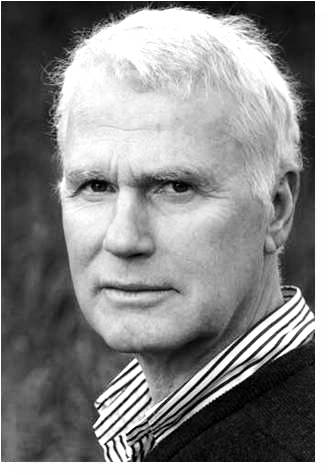

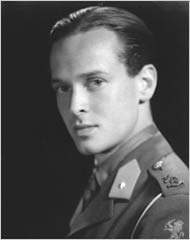
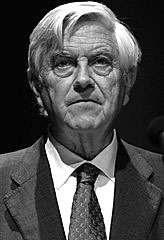
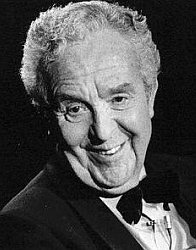
Wim Kan (Dutch Language) cabaret 1972.
"Almost no one is alive anymore."
"Who can tell the tale. Only the death know what happened along those Birma rails."
"Almost no one is alive anymore."
"Who can tell the tale. Only the death know what happened along those Birma rails."
Hella Haasse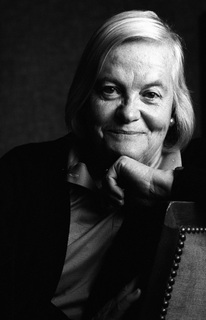
Hella S. Haasse (1918-2011)
Grand Dame of Dutch literature. Author of the classics : Heren van de Thee Oeroeg website Museum: http://www.hellahaassemuseum.nl/ |
Rudy Kousbroek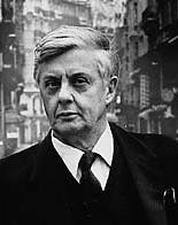
Rudy Kousbroek (Pematang Siantar 1929-2010), one of the foremost essayists of the Netherlands he was known for his sharp and erudite critical writings.
He was influential in drawing attention to authors he admired like Tjalie Robinson & Beb Vuyk. He was equally known for his literary beef with J.Brouwers (see below) as well as Tjalie's granddaughter Siem Boon. He was also deliberate in pointing out the excellence of the writings of Sutan Sjahrir, Indonesia's almost forgotten independence leader. His magnum opus is the book: Het Oostindisch kampsyndroom (The East Indian Camp Syndrome). |
Willem Nijholt
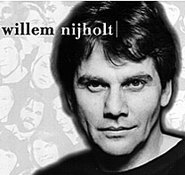
Willem Nijholt (Gombong 1934) is a famous Dutch actor and singer. His early life in the Indies and his affinity with Indos thas influenced his choice of acting roles. Due to this and of course his great acting talent many have mistaken Willem Nijholt to be an Indo himself.
Nijholt played an Indo in the television drama based on the book 'De Stille Kracht' by Louis Couperus. The other landmark performance is his role in the television series 'Kris Pusaka'.
In 2009 he performed a theatre play written by Yvonne Keuls and based on the book Oeroeg by Hella Haase.
Below a video clip of Nijholt singing with Wieteke van Dort in her iconic role as Tante Lien.
Nijholt played an Indo in the television drama based on the book 'De Stille Kracht' by Louis Couperus. The other landmark performance is his role in the television series 'Kris Pusaka'.
In 2009 he performed a theatre play written by Yvonne Keuls and based on the book Oeroeg by Hella Haase.
Below a video clip of Nijholt singing with Wieteke van Dort in her iconic role as Tante Lien.
Legendary writers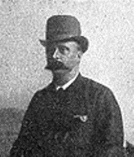
P.A.Daum (1850-1898), was a newspaper man in the true sense of the word. An autodidact and independent journalist he did not hesitate totaunt the authorities, which made him come into conflict with the colonial government.
He founded one of the most important newspapers in the DEI. His 'Bataviaasch Nieuwsblad' was one of the best read papers in the colony and became a mouthpiece for the Indo population. His protege and successor was in fact non other than Karel Zaalberg. Famous Indos that worked as editors for his newspaper include icons such as: Eddy du Perron, Ernest Douwes Dekker and even Tjalie Robinson. Most of Daums literary work was published in his own newspaper as a weekly series. His popular stories contributed to the commercial success of his newspaper. Only after his death Daum was discovered as one of the greats of Dutch literature. |
Multatuli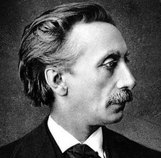
Eduard Douwes Dekker (1820–1887) is responsible for writing the great masterpiece of Dutch literature: Max Havelaar. One of the most significant and influential books in Dutch and Indonesian history.
An Indo descendant of the Dekker family, Ernest Douwes Dekker, would later become a key leader and tireless activist in the anti-colonial movement. Multatuli's own writings however did not show any particular insight into the Indo population of the DEI, nor was it in fact anti-colonial. Ernest D.D. on the other hand founded the first multi-cultural political party proclaiming an independent Indies and became an important inspiration for Indonesian revolutionaries like Sukarno. Free: Audio book. (Public domain) UNESCO archive |
Totok Artists
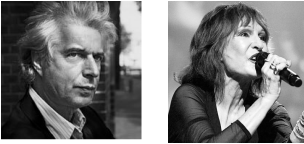
Boudewijn de Groot (Batavia 1944)
Liesbeth List (Bandung 1941)
Liesbeth List (Bandung 1941)
|
|
|
Totok Authors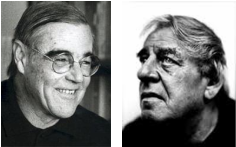
Pans Schomper (Batavia 1920-2010)
F.Springer (Batavia 1932-2011) J.Brouwers (Batavia 1940) Hans Vervoort (Magelang 1939) Nicolette Smabers (The Hague 1946) Kester Freriks (Jakarta, 1954) |
Helga Ruebsamen
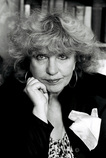
Helga Ruebsamen (Batavia 1934) Part of her work has been translated to English.
'The Song & The Truth' is a book set against the backdrop of the Dutch East Indies and Nazi-occupied Holland, this lyrical novel delivers epic themes–from the legacy of colonialism to the elusiveness of memory–filtered through the rich imagination of a five-year-old girl. |
Circumstances...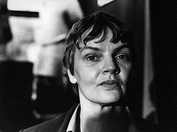
Mischa de Vreede (Batavia 1936)
"Circumstances, caused me too early to see how one human being can beat and kick another one and also that one must always bow to whoever is boss But bowing is done on the outside from the inside we don't bow." |
Xaviera Hollander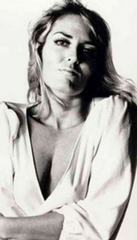
Xaviera 'Happy Hooker' Hollander (Surabaya 1943), former high class madam and writer of the 'scandalous' international best seller 'The Happy Hooker' a landmark book of the sexual revolution.
Vera de Vries (her real name) spent the first years of her life in a Japanese prison camp and left the Indies at a young age. Her writings so far are not directly inspired by the Indies. |
Totok authors - R.I.P.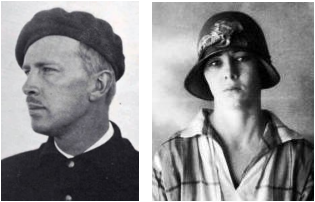
Johan Fabricius (Bandung 1899-1981) Madelon Székely-Lulofs (Surabaya 1899-1958) Albert Alberts (Haarlem 1911-1995) |
Mammie, ik ga dood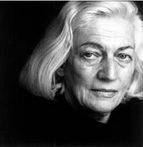
Margaretha Ferguson (Arnhem 1920-Vietnam 1992) Lived in the Dutch East Indies from 1929 to 1947). She once noted: "Even though I was not born there. The longer I live in the Netherlands, the more I am from the Indies. "
Books include: Hollands-Indische verhalen (1974); Nu wonen daar andere mensen... Terug op Java (1974); Mammie, ik ga dood (1975); Elias in Batavia en Jakarta (1977). |
Jane Seymour (Hollywood stage name)
Real name Joyce Penelope Wilhelmina Frankenberg. Born in the UK in 1951 from a Polish Jewish father and Dutch mother Mieke van Trigt, who survived the Japanese interment camps of WWII in Indonesia.
“I don’t think they ever imagined they would be in an internment camp, for three and a half years, being tortured and starved,” Seymour said. “It’s a part of the war most people don’t talk about or know about. … My mother wouldn’t talk about it, because she was of the belief that once she survived it, she wanted to sort of shut that door and move on.”
|
Edgar Vos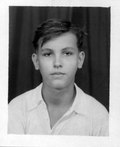
Edgar Vos (5 July 1931 – 13 January 2010) was a famous fashion designer.
Vos was born in Makassar in the Dutch East Indies in 1931. Survived the Japanese camps. Died in Florida. Click: Television interview about the Japanese camps. |
“When I was growing up, our house was full of usually, women, whose husbands had gone, and with children,” Seymour said. “Their kids became like sisters and brothers to us. Their mothers all became Auntie So and So.” “There was food in abundance even though we didn’t have much money. … If we had one piece of steak, and suddenly now there were 20 people, it became tiny morsels in a magnificently delicious rice dish that she was famous for,” Seymour said.
Now Seymour, her sisters and her daughters follow that example. “Without anyone trying to tell anyone to do it, it’s just sort of a custom that’s run in the family,” Seymour said.
Now Seymour, her sisters and her daughters follow that example. “Without anyone trying to tell anyone to do it, it’s just sort of a custom that’s run in the family,” Seymour said.
Fokker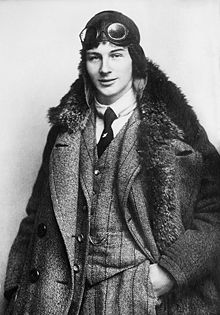
Anthony Fokker (1890–1939) the famous aviation pioneer was born in Blitar, Java, Dutch East Indies.
Together with the Indo Jan Hilgers Fokker set up his company in Germany and even Russia. |
Mata Hari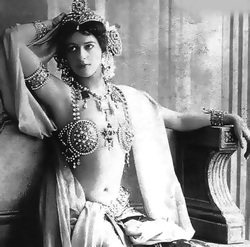
Margaretha Geertruida "Grietje" Zelle (1876-1917), the legendary Femme Fatale.
The idea of an exotic dancer working as a lethal double agent using her powers of seduction to extract military secrets from her many lovers made Mata Hari an enduring archetype of the femme fatale. According to an eyewitness account of her execution by firing squad, she was not bound and refused a blindfold. She defiantly blew a kiss to her executioners.
Song lyrics by Ofra Haza: "Like a butterfly she crossed all the lines / Like a butterfly she dreamt, danced and died" "But a great love cut her life".
|
Prime-Minister Rutte
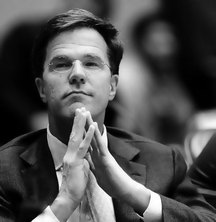
Mark Rutte became Prime-Minister of the Netherlands in 2010.
As the youngest son he was born into an expatriate 'Totok' family originally from the Dutch East Indies. His father was a Japanese POW.
Click: TV interview 2011.
As the youngest son he was born into an expatriate 'Totok' family originally from the Dutch East Indies. His father was a Japanese POW.
Click: TV interview 2011.
"At home we were surrounded by memories of life in the Dutch East Indies," said Rutte. He mentioned the smell that hung in his parental home, the nasi goreng on Saturday evening, the Indonesian/Malay words - soebatten, mataglap - which he still unconsciously uses to this day.
Seldom the Dutch prime-minister was able to draw so much on his own experiences for a commemoration speech as here at the commemoration of the end of the Second World War in the Dutch East Indies, now 75 years ago. (2020)
Rutte told how he heard many stories about the Indies. But how there was always a "dark corner" that his father usually skipped. During the war, Rutte's father was placed in a Japanese camp for prisoners of war, his wife was also interned with her three children. She would die from exhaustion shortly before liberation; his father would remarry after the war and have four more children, including young Mark.
Seldom the Dutch prime-minister was able to draw so much on his own experiences for a commemoration speech as here at the commemoration of the end of the Second World War in the Dutch East Indies, now 75 years ago. (2020)
Rutte told how he heard many stories about the Indies. But how there was always a "dark corner" that his father usually skipped. During the war, Rutte's father was placed in a Japanese camp for prisoners of war, his wife was also interned with her three children. She would die from exhaustion shortly before liberation; his father would remarry after the war and have four more children, including young Mark.
Politicians
|
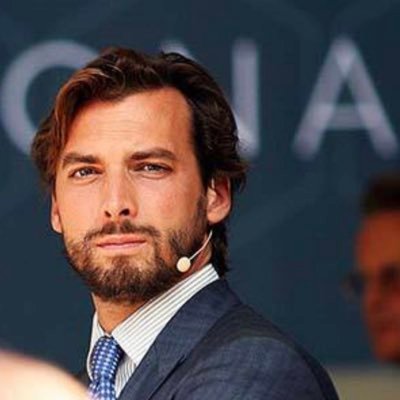
Thierry BAUDET is a prominent right wing populist politician. His great great grandmother was Indo, but he does not necessarily consider himself Indo.
|
|
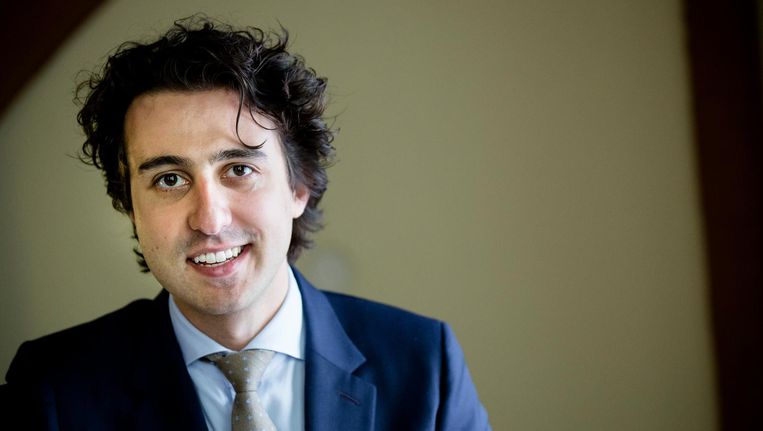
Jesse Klaver is a pr0minent left wing politician. His mother is Indo. But so far he has not claimed Indo identity.
|
Minister Jet Bussemaker
Minister and former State Secretary Jet Bussemaker joined the Board of the Indies Memorial Center Bronbeek in Arnhem in January 1, 2011. As Secretary of the Ministry of Health, Welfare and Sport (VWS) she developed the fourth national WWII memorial center, one that is dedicated to the war in the Dutch East Indies and Indonesia. To prevent underexposure of the Dutch East Indies heritage she cleared a special place for it in the programme.
Her father, born in 1928, was a camp child. In the late eighties Bussemaker went with her father to Indonesia to the stories and the war of his youth. May 2011 she published a book about her experiences as the daughter of a camp child: "Daughter of a camp child". |
|
Soldiers of Orange.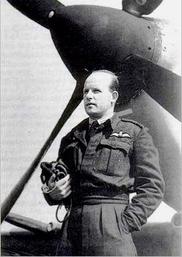
A remarkably large percentage of Dutch resistance fighters during WWII were both Indo and Totok natives from the Dutch East Indies.
Indos like the father of Ernst Jansz were among the first to resist the Nazi occupier. Also among the student resistance many were born and raised in the Indies. 2 Totok companions of Erik Hazelhoff the original Soldier of Orange (Surabaya, Java) were the much decorated war heroes Bram van der Stok (Sumatra) and Peter Tazelaar (Java). Picture: Bram van der Stok, the most decorated Dutch aviator in history. |
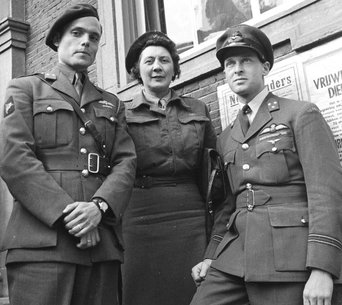
Tazelaar with baret and Hazelhoff with hat.
|
With 11% the third largest group of the so called "Englandvaarders" were resistance fighters born and raised in the Dutch East Indies. Of the 900 Dutch military men assigned to the the Royal British Airforce (RAF) as many as 209 (23%) were born in the Dutch East Indies.
Source: https://www.historischnieuwsblad.nl/indische-nederlanders-in-het-verzet/
Researcher: http://www.hermankeppy.com/
Researcher: http://www.hermankeppy.com/
Sportsmen
Elisa Hendrik "Beb" Bakhuys (Pekalongan, Java, 16 April 1909 – 7 July 1982) Football player, second Dutch international in history.
|
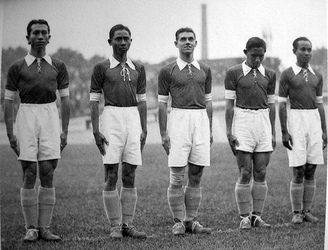
D.E.I. competed in the 1938 FIFA World Cup. First Asian team ever to do so. 4 years earlier they beat Japan at the Far Eastern Games with 7-1.
|
|
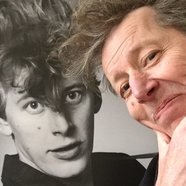
Jan Rot (born in Makassar on 25 December 1957) from a Dutch mission docter is a singer-songwriter who is famous in the Netherlands for his many translations of songs, pop as well as classical ones. His Dutch translation of Bach's St Matthew Passion peaked in the Dutch pop album charts. He worked with Indo diva Anneke Gronloh and honored her in the 50 year jubilee concert of 2009.
|
